
ATLANTIC ODYSSEY
Expedition Cruise
From Ushuaia to Cape Verde
A 34-day oceanic expedition across the Atlantic to discover remote islands and pristine marine wildlife.
The ultimate pelagic journey has arrived. This 34-day transatlantic voyage crosses the South and North Atlantic from Ushuaia to Cape Verde, sailing through some of the most productive oceanic waters on Earth. It is a journey designed for true naturalists, birders, and wildlife photographers, offering an unmissable opportunity to encounter vast colonies of penguins, gliding albatrosses, whales, and flying fish in their purest habitats. Guided by onboard photography workshops and expert naturalists, this unique passage explores legendary, seldom-visited islands like South Georgia, Tristan da Cunha, and Saint Helena.
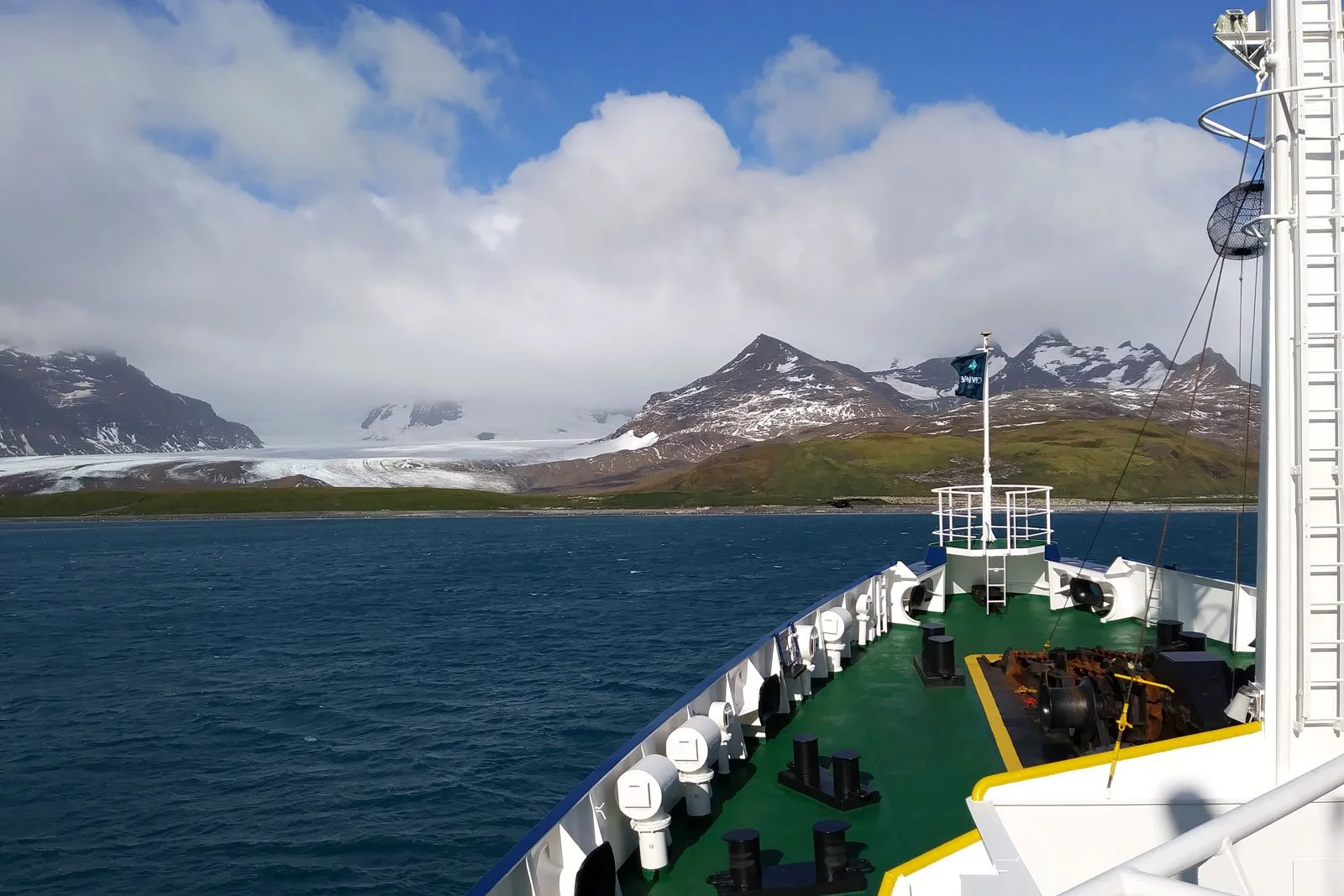
The open waters of the South and Equatorial Atlantic host some of the most productive pelagic habitats in the world ocean. This 34-day expedition aboard the m/v Plancius covers vast marine expanses and navigates past remote archipelagos—starting in Ushuaia and ending in Cape Verde, pushing deep into the oceanic wilderness of South Georgia, Tristan da Cunha, and Saint Helena.
The route is designed around pelagic wildlife observation and photography, where spending the days exploring rich currents and isolated island habitats is the core point of the journey. Seabirds, marine mammals, flying fish, whales, and dolphins are frequently seen from the ship through waters and offshore outposts that very few travelers ever reach, and the wild mid-ocean landscapes are the ornithological and zoological centerpiece of the crossing.
Expert naturalists and photography mentors lead the journey, offering daily workshops and dedicated guidance on open-sea observation, ensuring every day at sea brings you intimately closer to capturing the wildlife and fleeting moments of the open ocean.
Trip Overview
Where and when?
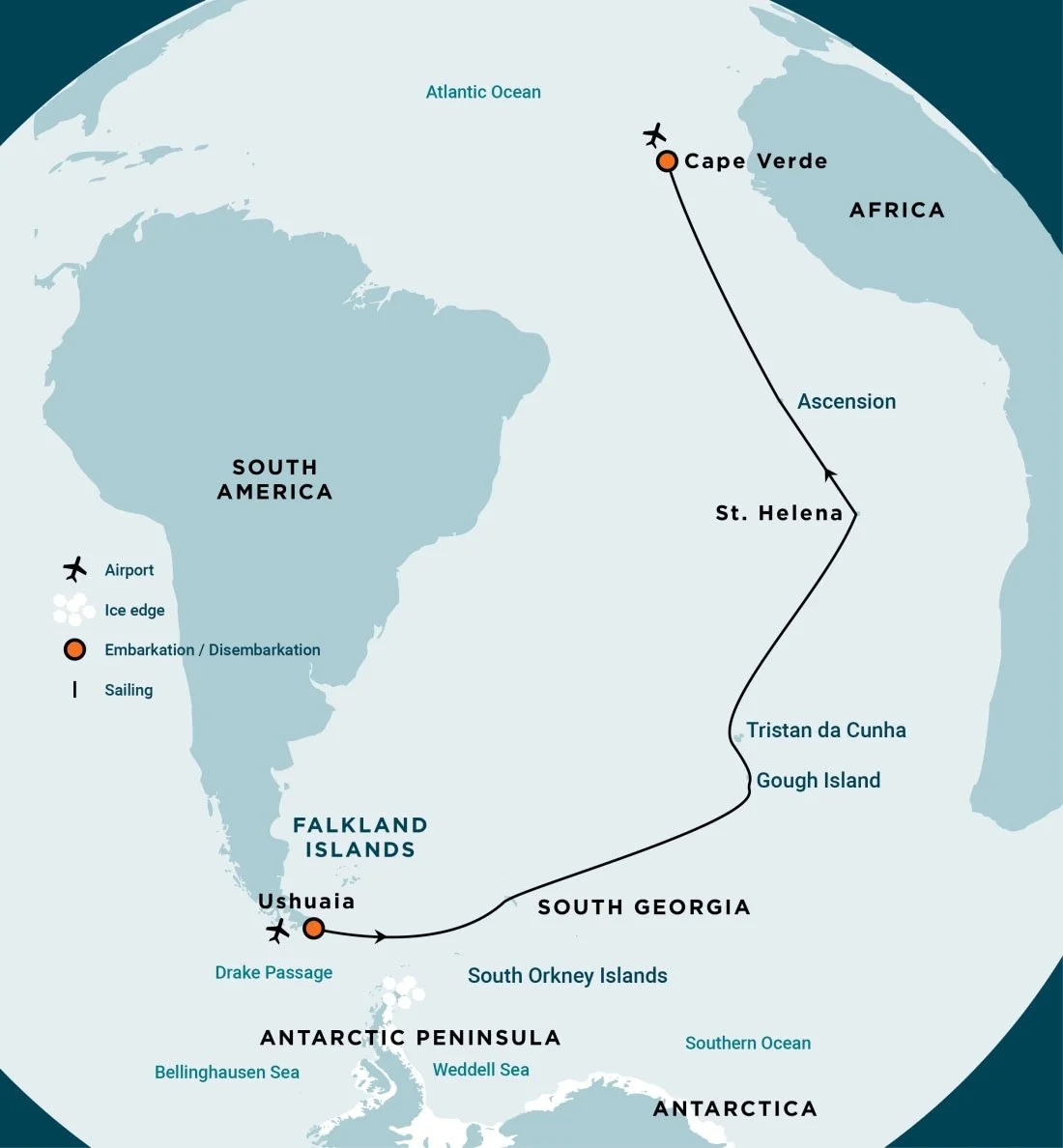
The expedition departs from Ushuaia, Argentina, on 04 April 2027 and arrives 33 nights later on 07 May 2027 in Praia, Cape Verde. The maritime track heads northeast across the entire Atlantic basin, tracing a route that connects sub-Antarctic archipelagos with remote volcanic islands in the Mid-Atlantic Ridge before disembarking off the West African coast.
April to May offers a unique transition period for this trans-equatorial crossing. Setting sail during the Southern Hemisphere's autumn allows navigation through cold, nutrient-rich South Atlantic waters around South Georgia and Gough Island. As the ship progresses northward toward Tristan da Cunha, Saint Helena, and Ascension, the crossing enters warm tropical latitudes, providing optimal open-ocean light and sea conditions for observing wildlife shifts across different climate zones.
Tour Itinerary
-
Your voyage begins where the world drops off: Ushuaia, Argentina, said to be the southernmost city on the planet, located on the far southern tip of South America. Starting in the afternoon, we embark from this small resort town on Tierra del Fuego (nicknamed “The End of the World”) and sail the mountainous Beagle Channel for the rest of the evening.
-
Today we are en route to South Georgia. After passing the Antarctic Convergence, which is a natural boundary formed when north-flowing cold waters collide with warmer sub-Antarctic waters, we enter the circum-Antarctic upwelling zone. Not only does the marine life change, the bird life changes, too: A variety of albatrosses and petrels show up, along with Cape pigeons and southern fulmars.
-
Our aim today is to visit some of the world’s top king penguin rookeries. This time of year you have a good chance of seeing these animals nesting on eggs, with their chicks nearby. The rookeries are sometimes overflowing, with penguins traveling to and from the beach.
Possible visits in this region include:
Salisbury Plain, St. Andrews Bay, Gold Harbour – Here you can see not only the massive king penguin colony, but also elephant seals and limitless fur seal pups playing in the surf.
Grytviken – We also have the opportunity to check out this abandoned whaling station, where king penguins walk the streets and elephant seals lie around like they own the place – because they basically do! You might also see the South Georgia Museum as well as Shackleton’s grave here.
Cooper Bay – This is a fine place for a Zodiac cruise, and this bay also houses a rookery of macaroni penguins. King penguins, pintails, and giant petrels may also appear here.
Moltke Harbour – Located in Royal Bay, this scenic spot gives you the chance to see the huge king penguin colony that lives here.
-
A pleasant tailwind often accompanies the vessel through the westerlies, and on both sides of the Antarctic Convergence, you might see large numbers of Antarctic and sub-Antarctic seabirds.
-
Today we plan to approach Gough Island for a Zodiac cruise in Quest Bay, if the weather permits. Here you might see northern rockhopper penguins and sub-Antarctic fur seals. In previous years, it has been possible for us to circumnavigate most of Gough Island’s 33-mile circumference, taking in this area’s splendid scenery and abundant wildlife.
-
The remote islands of Tristan da Cunha are famed for their plentiful bird populations, which include rockhopper penguins, several species of albatross, petrels, skuas, terns, and many others. Our goal during this stage of our voyage is to visit the small settlement on the west side of the main island, but we might also land at Seal Bay on the south side of Tristan da Cunha or at Sandy Point on the east side.
In these stunning locations, you could encounter such exotic wildlife as yellow-nosed albatrosses and sub-Antarctic fur seals, all while exploring a rarely visited spot. We also intend to land at Nightingale Island and Inaccessible Island, both of which offer great views of beautiful seabirds ranging from yellow-nosed albatrosses to brown noddies.
Two days are reserved at Tristan da Cunha in case of bad weather, but please remember that nature determines our itineraries here: Since beginning the Atlantic Odyssey cruise in 1998, adverse weather led to the cancellation of 35% of Tristan da Cunha landings. If we have to divert for safety reasons, we will find good alternatives.
-
Seabirds and dolphins indigenous to this region often follow the vessel.
-
On our visit to Saint Helena, we’ll experience the island's perfect balance of wildlife, and history. The island is home to the endemic and endangered Wirebird, or St. Helena Plover which we will likely spot in the fields at the center of the island. The coastline is alive with nests of White Terns, while Red-billed Tropicbirds and noddies often circle around our vessel. For those interested in history, a visit to Longwood House, where Napoleon spent his final years, is a must for its historical significance. If you're looking for adventure, we can take short hikes, snorkel in the shallows, or embark on a boat trip to explore the seabird colonies and possibly encounter dolphins up close.
➢ You have the option to disembark and fly back home from Jamestown Airport in Saint Helena (HLE). Please contact us at warblertours@gmail.com for details and pricing of the short itinerary.
➢ For those continuing on to Cape Verde, the ship will set sail in the evening of Day 23.
-
As we leave St. Helena behind, our ship sets course for the Mid-Atlantic Ridge, an underwater mountain range stretching from the Arctic to the southern tip of Africa. The journey ahead promises to be full of excitement as we begin to encounter Cory’s Shearwaters and Sooty Terns. When night falls, our expert expedition guides from Oceanwide, will invite us to the aft deck for a stargazing experience like no other. Together, we’ll point out the many wonders of the equatorial sky. Weather permitting, the starry sky will be visible with the naked eye, or we can use binoculars to spot even more details in this incredible celestial showcase. As we sail deeper into the Atlantic, we’ll soon witness the highest density of flying fish of the entire trip.
During this part of our journey, we’ll experience the highest density of flying fish of our entire trip. We’ll certainly make it a priority to capture this incredible spectacle in as much detail as possible.
-
Ascension Island is a volcanic landmass with a dry environment and a lush, verdant peak known as Green Mountain. We'll cruise offshore to the remarkable Boatswain Bird Island. This natural stack is home to thousands of Ascension Frigatebirds, and we'll also have the chance to see Red-footed, Brown, and Masked Boobies, along with White-tailed Tropicbirds, all competing for prime nesting sites.
-
As we sail into the northern hemisphere, Arctic Terns and Long-tailed Skuas will join us on their northward spring migration. The seabird sightings will become more varied, with Cape Verde Shearwaters, White-faced Storm-Petrel and luckily Cape Verde Storm Petrels. We anticipate the exciting moment when we cross the Equator—who knows, we might even have a chance to meet King Neptune! If the weather is on our side, we’ll have another opportunity to enjoy stargazing from the deck, where we can observe the Polar Star making its appearance on the northern horizon.
-
We will sail by Ilhéus do Rombo and Sao Filipe on Fogo Island, offering a chance to spot some of the Western Palearctic species. An excellent opportunity to observe diverse bird species and enjoy the scenic views of the island from the water.
-
We’ll arrive in Praia, the capital of Santiago Island in Cape Verde, with disembarkation planned for 18:00. While no lunch will be served on this day, we can still relax onboard or safely store our luggage until it’s time to depart. We could join for an optional tour to Praia and its surroundings to visit Cidade Velha, a UNESCO World Heritage Site rich in history. Highlights include the imposing hillside fortress built to ward off English raiders, the oldest Christian church in the tropics, and the sobering slave whipping post in the main square. For birding, there are opportunities to venture out in search of Cape Verde’s endemic bird species before flying back home.
In Cape Verde, we will conclude this unforgettable adventure.
Prices and cabins
Available dates for 2027
Cabin options
Rates are shown per person, based on shared cabin occupancy. Single occupancy is available for selected double cabins at 1.7× the shared rate, subject to availability. The applicable single occupancy price will be confirmed when you submit the request form below.
Included in this voyage
- Voyage aboard the vessel indicated in the itinerary
- Support from our Warbler Tours team throughout booking and planning, as well as during your expedition
- All meals throughout the voyage aboard the ship, including snacks, coffee and tea
- All shore excursions and activities throughout the voyage by Zodiac
- Program of lectures by noted naturalists and leadership by experienced expedition staff
- Complimentary use of waterproof neoprene expedition muck boots and snowshoes
- Transfers and baggage handling between the airport, hotels and ship, only for passengers on a selection of flights to and from Longyearbyen
- All miscellaneous service taxes and port charges throughout the programme
- AECO fees and governmental taxes
- Comprehensive pre-departure material
- Complimentary Wi-Fi connectivity. All guests receive 1.5 GB of data usage per day, which resets every 24 hours
- Complimentary Dopper water bottle for use during and after your expedition
Not included in this voyage
- Any airfare, whether on scheduled or charter flights
- Pre- and post-land arrangements
- Passport and visa expenses
- Government arrival and departure taxes
- Meals ashore
- Baggage, cancellation and personal insurance (which is strongly recommended)
- Excess baggage charges and personal expenses such as laundry, bar, beverage and telecommunication charges
- The customary gratuity at the end of the voyage for stewards and other service personnel aboard
- Transaction costs
How to book a tripCómo reservar un viajeCom reservar un viatge
Three simple steps to get you there.Tres pasos sencillos y estarás en camino.Tres passos senzills i ja estaràs en camí.
Booking form
Prefer to write directly?
Reach us at warblertours@gmail.com or on WhatsApp.